


 PDF Version Demo
Simulation test system
It is necessary to strictly plan the reasonable allocation of Mule-Dev-301 test time in advance. Many students did not pay attention to the strict control of time during normal practice, which led to panic during the process of examination, and even some of them are not able to finish all the questions. If you purchased Salesforce Certified MuleSoft Developer II learning tool, each of your mock exams is timed automatically by the system. Mule-Dev-301 exam learning materials provide you with an exam environment that is exactly the same as the actual exam. It forces you to learn how to allocate exam time so that the best level can be achieved in the examination room. At the same time, Mule-Dev-301 test question will also generate a report based on your practice performance to make you aware of the deficiencies in your learning process and help you develop a follow-up study plan so that you can use the limited energy where you need it most. So with Mule-Dev-301 study tool you can easily pass the exam.
With the assist of Mule-Dev-301 practice demo, your goals to get the Mule-Dev-301 certification will be very easy to accomplish and 100% guaranteed. Before you choose our Salesforce Certified MuleSoft Developer II study tool, you can try our Mule-Dev-301 free demo for assessment. For a better idea you can also read Mule-Dev-301 testimonials from our previous customers at the bottom of our product page to judge the validity. Our updated and useful Mule-Dev-301 will be the best tool for your success.

Unlimited use
The paper materials students buy on the market are often not able to reuse. After all the exercises have been done once, if you want to do it again you will need to buy it again. But with Mule-Dev-301 test question, you will not have this problem. All customers who purchased Mule-Dev-301 study tool can use the learning materials without restrictions, and there is no case of duplicate charges. For the PDF version of Mule-Dev-301 test question, you can print multiple times, practice multiple times, and repeatedly reinforce your unfamiliar knowledge. For the online version, unlike other materials that limit one person online, Salesforce Certified MuleSoft Developer II learning materials do not limit the number of concurrent users and the number of online users.
First-class service
The customer is God. Salesforce Certified MuleSoft Developer II learning tool provide all customers with high quality after-sales service. After your payment is successful, we will dispatch a dedicated IT staff to provide online remote assistance for you to solve problems in the process of download and installation. During your studies, Mule-Dev-301 study tool will provide you with efficient 24-hour online services. You can email us anytime, anywhere to ask any questions you have about our Mule-Dev-301 study tool. At the same time, our industry experts will continue to update and supplement Mule-Dev-301 test question according to changes in the exam outline, so that you can concentrate on completing the review of all exam content without having to pay attention to changes in the outside world.
Salesforce Mule-Dev-301 Exam Syllabus Topics:
| Section | Weight | Objectives |
|---|---|---|
| Topic 1: Implement Monitorable Mule Applications | 15% | - Expose health check endpoints - Implement logging and log management - Implement message correlation - Monitor applications and runtimes |
| Topic 2: Secure Data at Rest and in Transit | 20% | - Implement security policies - Manage keys and certificates - Expose and invoke APIs over HTTPS - Manage secure environment properties |
| Topic 3: Implement Maintainable and Modular Mule Applications and Maven Builds | 25% | - Build custom policies and processors - Execute tests with Maven - Create reusable libraries - Implement automated deployment - Modularize applications and builds |
| Topic 4: Design and Implement API-led Connectivity | 13% | - Implement server-side caching - Implement HTTP callbacks/webhooks - Implement API autodiscovery |
| Topic 5: Implement Performant and Reliable Mule Applications | 27% | - Validate messages and payloads - Handle HTTP API invocations and errors - Implement reliable messaging patterns - Use ObjectStore for persistence - Optimize performance and throughput |
Salesforce Certified MuleSoft Developer II Sample Questions:
Question #1
Refer to the exhibits.
Bioinfo System API is implemented and published to Anypoint Exchange. A developer wants to invoke this API using its REST Connector.
What should be added to the POM?
A. 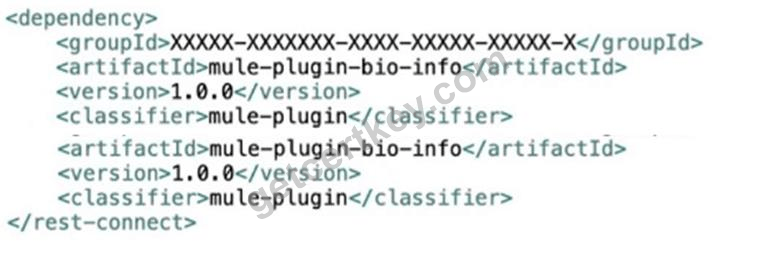
B. 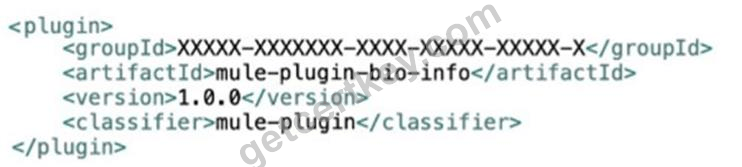
C. 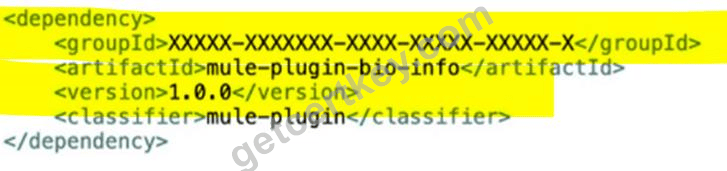
D. 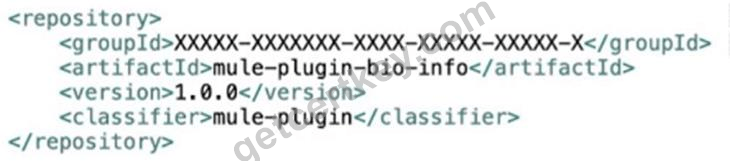
E. 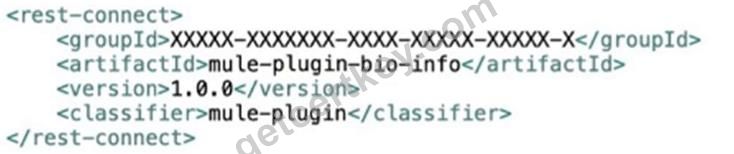
Question #2
A company has been using CI/CD. Its developers use Maven to handle build and deployment activities.
What is the correct sequence of activities that takes place during the Maven build and deployment?
A. Validate, initialize, compile, test package, verify, install, deploy
B. Validation, initialize, compile, test, package, install verify, deploy
C. Validate, initialize, compile, package, test, install, verify, verify, deploy
D. Initialize, validate, compute, test, package, verify, install, deploy
Question #3
Which type of cache invalidation does the Cache scope support without having to write any additional code?
A. Write-through invalidation
B. Time to live
C. Notification-based invalidation
D. White-behind invalidation
Question #4
A developer has created the first version of an API designed for business partners to work commodity prices.
What should developer do to allow more than one major version of the same API to be exposed by the implementation?
A. In Anypoint Studio, generate scaffolding from the RAML, and then modify the flow names generated by APIKit to include a variable with the major version number
B. In Design Center, open the RAML and modify each operation to include the major version number
C. In Anypoint Studio, generate scaffolding from the RAML, and the modify the <http:listerner> in the generated flows to include a parameter to replace the version number
D. In Design Center, open the RAML and modify baseUn to include a variable that indicates the version number
Question #5
A Mule application need to invoice an API hosted by an external system to initiate a process. The external API takes anywhere between one minute and 24 hours to compute its process.
Which implementation should be used to get response data from the external API after it completes processing?
A. Use an HTTP Connector to invoke the API and wait for a response
B. Use an HTTP Connector inside Async scope to invoice the API and wait for a response
C. Use a Scheduler to check for a response every minute
D. Expose an HTTP callback API in Mule and register it with the external system
Solutions:
| Question #1 Answer: B | Question #2 Answer: A | Question #3 Answer: B | Question #4 Answer: D | Question #5 Answer: D |


 What Our Customers Are Saying:
 Megan
Megan

 Quality and ValueGetCertKey Practice Exams are written to the highest standards of technical accuracy, using only certified subject matter experts and published authors for development - no all study materials.
 Tested and ApprovedWe are committed to the process of vendor and third party approvals. We believe professionals and executives alike deserve the confidence of quality coverage these authorizations provide.
 Easy to PassIf you prepare for the exams using our GetCertKey testing engine, It is easy to succeed for all certifications in the first attempt. You don't have to deal with all dumps or any free torrent / rapidshare all stuff.
 Try Before BuyGetCertKey offers free demo of each product. You can check out the interface, question quality and usability of our practice exams before you decide to buy.